
During a University Council meeting attended by the Vice Minister for Educational Affairs of the Ministry of Science, Research, and Technology, the President of the University of Kurdistan (UOK) presented a comprehensive report on the university’s current standing in education, research, finance, and infrastructure. Highlighting the institution's scientific and research achievements, he emphasized the necessity of securing Kurdistan Province's fair share of the country's higher education resources.
Report by the President of the University of Kurdistan on the University’s Educational, Research, Financial, and Developmental Status
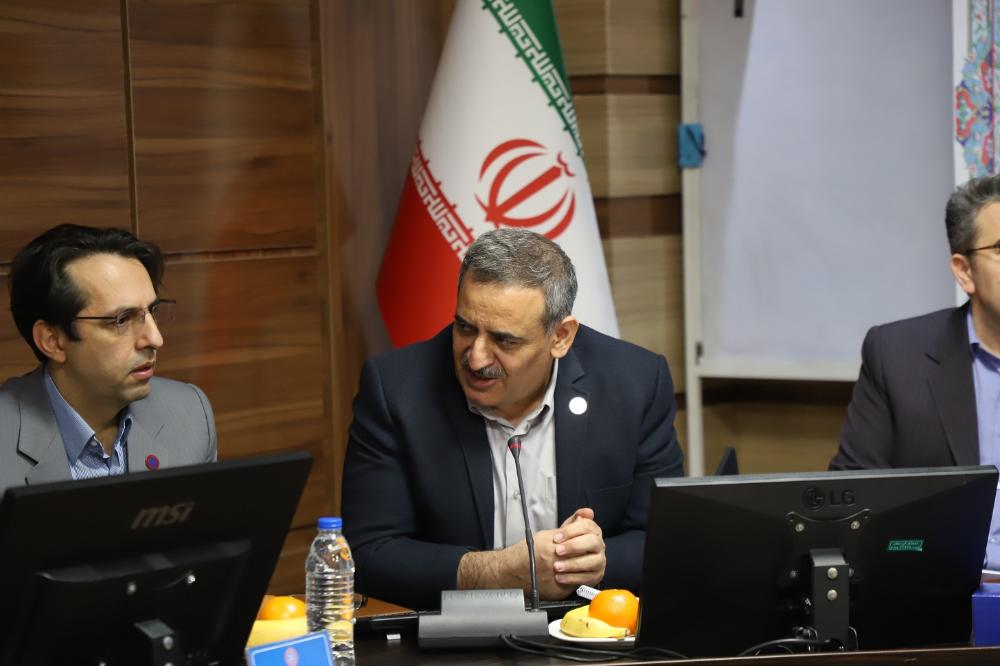



According to a report by UOK Public Relations, Dr. Adel Siosermardeh, the President of the University of Kurdistan, delivered an extensive report on Monday, February 9 (20 Bahman), detailing the university's current status across various domains. By comparing the university’s indicators with national averages, he underscored the need for educational equity for Kurdistan Province.
Dr. Siosermardeh stated that the University of Kurdistan comprises a main campus with seven active faculties: Engineering, Science, Agriculture, Natural Resources, Language and Literature, Humanities and Social Sciences, and Art and Architecture. He added that the university also operates two satellite faculties—the Faculty of Engineering and Science in Bijar and the Faculty of Industry and Mining in Qorveh—while a third satellite faculty for Agriculture and Natural Resources is currently under construction in Saqqez.
The President noted that UOK currently hosts 10,310 students, including 7,809 undergraduate, 1,985 Master’s, and 516 PhD students across 55 academic departments. Furthermore, the university hosts 544 international students from six different nationalities. He added that the number of faculty members stands at 398 for the year 1404 (2025-2026), with an additional 35 in the recruitment process, bringing the total expected faculty count to 433 by year-end.
According to the latest ISC rankings released on April 13, 2025 (24 Farvardin 1404), the University of Kurdistan ranked 19th among 115 public and 21 private universities in Iran. In this assessment, UOK surpassed several prominent institutions, including Shahid Chamran University of Ahvaz, Bu-Ali Sina University of Hamedan, the University of Mazandaran, the University of Zanjan, and Shahid Madani University of Azerbaijan.
The Standing of UOK Faculty Among the World's Top Scientists
Highlighting the university’s scientific prestige, Dr. Siosermardeh noted that nine faculty members are currently ranked among the top 1% of scientists worldwide. Furthermore, nine researchers from Kurdistan Province are featured in the Ministry of Science’s list of 379 top researchers, demonstrating high research productivity relative to the province’s population and human resources.
Research Productivity Exceeding Faculty Share
The President observed that while UOK faculty members constitute approximately 1.4% of the nation’s total faculty, the university’s research efficiency remains significantly higher than the national average. He added that 23 faculty members are recognized as prominent regional scientists, a notable figure compared to peer institutions.
National and Scientific Honors
Referring to recent achievements, Dr. Siosermardeh mentioned that the university received several national honors this year, including two faculty members being selected as recipients of the prestigious Allameh Award.
Provincial Demographics and the Demand for Educational Equity
Discussing demographic indicators, he noted that Kurdistan Province’s population of approximately 1.66 million represents nearly 2% of the national population. Consequently, it is expected that the University of Kurdistan’s share in higher education indicators—including student enrollment, budget, and human resources—should reach at least 2%.
Significant Student Deficit Relative to Provincial Share
The President explained that the current student population of 10,300 is below the expected 13,060 based on provincial demographics, leaving a deficit of approximately 2,500 to 2,700 students.
Dormitory Crisis at the University of Kurdistan
Regarding student housing, Dr. Siosermardeh reported that 5,200 students currently reside in dormitories, whereas the expected share based on demographics and climate should be around 4,400. This creates excessive pressure on facilities. He noted that many students cannot afford private rentals, and others face commuting difficulties during winter from surrounding villages, necessitating the expansion of dormitory infrastructure.
Faculty Shortage
He pointed out that the university currently has 386 faculty members, while the national average ratio suggests it should have at least 532. It is anticipated that with new recruitments, this number will reach 470 by the end of next year.
Graduate Education and PhD Challenges
Dr. Siosermardeh stated that UOK’s share of undergraduate students is 1.8%, close to the province's population share. However, its share of Master’s students is 1.1%, and its share of PhD students is only 0.7%. He stressed that achieving a fair provincial share requires a serious increase in graduate capacity, particularly at the doctoral level, through the authorization of new academic programs. He also noted that four university journals received official scientific rankings over the past year.
Increased Scientific Production Against National Decline
While Iran’s national scientific production has declined over the past three to four years, the University of Kurdistan achieved a 7% growth in research indicators, partially offsetting the national downturn.
The 200% Growth in Approved Research Projects
The President revealed that the number of research projects approved by the Iran National Science Foundation (INSF) rose from 9 in 1403 to 27 in the first ten months of 1404, marking a 200% increase. While the national average growth for such projects was 32%, UOK’s growth rate was approximately six times the national average.
In conclusion, Dr. Siosermardeh emphasized that despite limitations, UOK possesses high scientific and human potential. Provided it receives a fair share of resources, credits, and authorizations, the university can play a more effective role in the scientific, cultural, and economic development of the region.


Quick Links
Electronic Services
Useful Links

University of Kurdistan, Pasdaran Boulevard, Sanandaj, Iran

Postal Code: 6617715175

Phone: +988733664600-8

Email: info@uok.ac.ir


site visit
- today:
- yesterday:
- all:
Last Update
10 Feb 2026 - 11:32:02