A New Milestone for the University of Kurdistan in International Academic Assessments
University of Kurdistan Ranks 601–800 Globally in the THE Interdisciplinary Science Rankings 2027
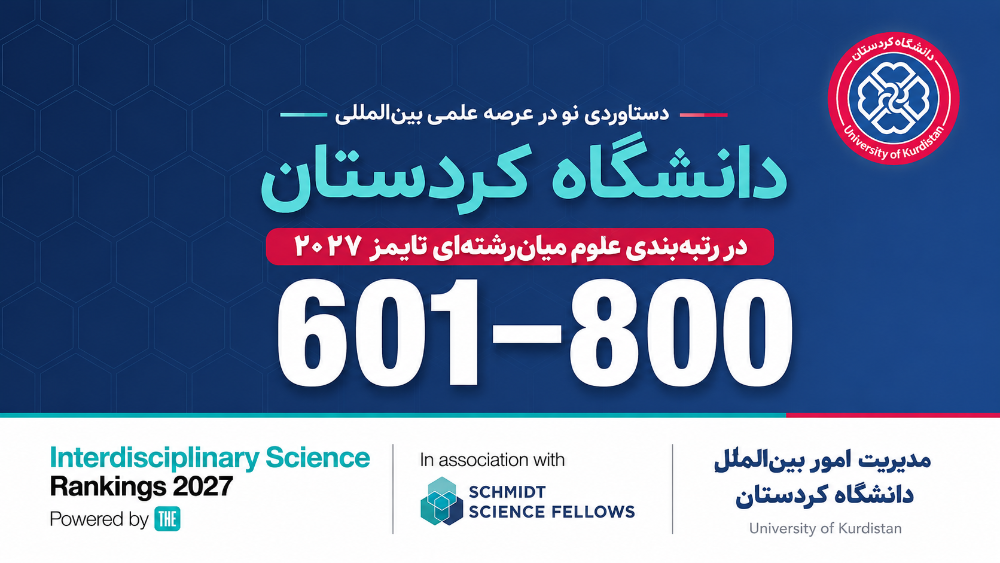



According to the 2027 Times Higher Education Interdisciplinary Science Rankings, the University of Kurdistan placed in the 601–800 global bracket. This marks the third edition of the rankings, developed in partnership with Schmidt Science Fellows.
About the Ranking The THE Interdisciplinary Science Rankings is the first international ranking system dedicated specifically to measuring universities' contributions and institutional commitment to interdisciplinary research. Its theoretical foundation rests on the premise that addressing complex global challenges requires integrating knowledge, traditions, and methodologies across multiple scientific disciplines. Within this framework, interdisciplinary research encompasses not only the integration of core scientific fields with one another, but also the intersection of science with social sciences, education, psychology, law, economics, and clinical and health sciences.
Methodological Framework The ranking’s methodology is structured around 11 indicators across three pillars, each representing a stage in the lifecycle of research projects:
-
Inputs (19%): The proportion of research income dedicated to interdisciplinary science and the level of industry funding per academic staff member.
-
Process (16%): Documented and publicly available evidence of interdisciplinary success metrics, physical facilities, administrative support, and promotion and tenure policies for faculty members.
-
Outputs (65%): The volume and proportion of interdisciplinary publications, their utility and citation impact outside their core discipline, research quality, and the university's academic reputation in an international survey of researchers.
Data is drawn from three primary sources: institutional data submitted directly by universities through the official THE portal and subsequently verified, bibliometric data sourced from Elsevier’s Scopus database, and results from a global survey of active researchers. To qualify for inclusion, institutions must publish at least 100 interdisciplinary research outputs over a five-year period and employ a minimum of 50 academic and research staff across relevant scientific fields. In this system, only the top 200 universities receive exact numerical ranks, while remaining institutions are grouped into banded tiers.
The University of Kurdistan’s Achievement The inclusion of the University of Kurdistan in this international table signifies that the institution has met all rigorous eligibility criteria and stands among global universities evaluated under standardized benchmarks. The university’s Office of International Affairs attributes this accomplishment to the accurate and documented submission of institutional data, the sustained dedication of faculty members, researchers, students, and staff, and a strategic institutional focus on convergent scientific approaches. Looking ahead, strengthening research infrastructure, supporting interdisciplinary initiatives, and expanding academic and industrial collaborations are expected to elevate the university's international standing in future editions.
Further Reading:
-
Full results of the THE Interdisciplinary Science Rankings 2027: timeshighereducation.com/world-university-rankings/interdisciplinary-science-rankings
-
Ranking methodology: timeshighereducation.com/interdisciplinary-science-rankings/methodology

Faculty Systems

Student Systems

Staff Systems

Virtual Tour

Telephone Directory

Privacy Policy Statement
دسترسی سریع
خدمات الکترونیک

University of Kurdistan, Pasdaran Boulevard, Sanandaj, Iran

Postal Code: 6617715175

Phone: +988733664600-8

Email: info@uok.ac.ir


site visit
- today:
- yesterday:
- all:
Last Update
22 Nov 2026 - 05:10:45